Case Study: Building “Ask Daytona” — Advanced AI Inside a Municipal Citizen Engagement Platform
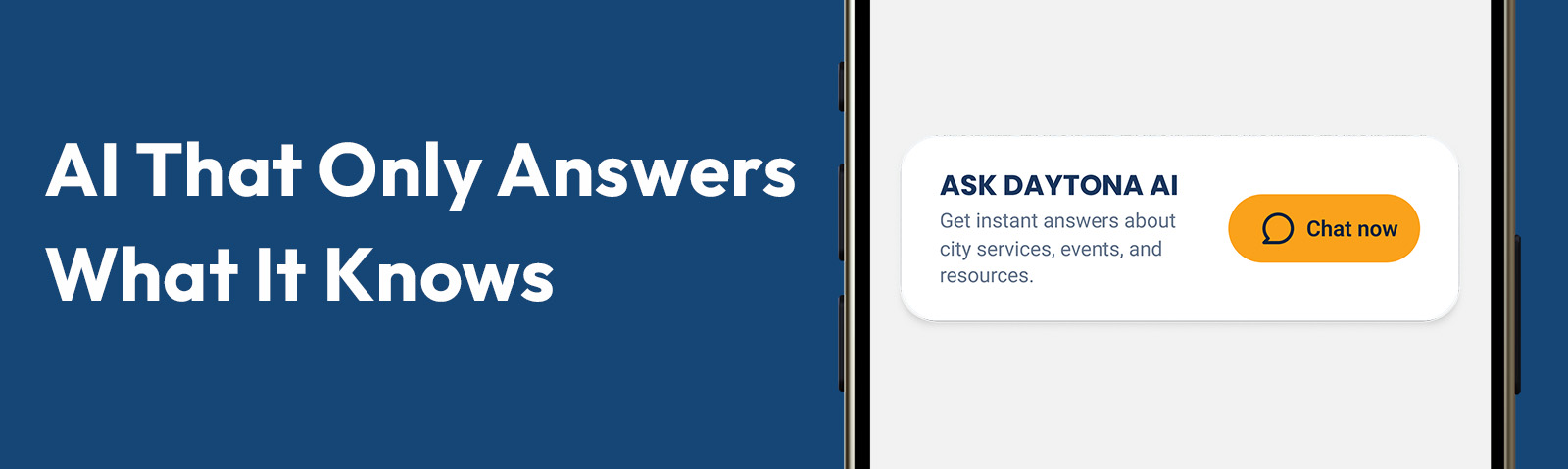
How Sweent built a grounded AI assistant into the City of Daytona Beach's citizen engagement app — one that answers only from the City's own published information, cites its source every time, and declines rather than guesses.
The problem
Residents ask cities the same few hundred questions. When is bulk pickup on my street? How do I get a permit for that? Where do I pay my water bill? What time does the pool open?
Every one of those answers already existed on the City's website. The problem was never that the information was missing — it was that finding it meant navigating a municipal site on a phone, guessing which department owns the answer, and knowing the vocabulary the City uses instead of the vocabulary residents use.
The City of Daytona Beach asked Sweent to close that gap inside its new citizen engagement app.
The constraint that shaped everything
Municipal AI has one failure mode that matters more than all the others: a city cannot afford to give a resident a confidently wrong answer. Not about a permit deadline, not about a code enforcement rule, not about a storm shelter.
That constraint eliminated the obvious approach. A general-purpose chatbot pointed at a large language model will answer anything — including questions it has no business answering, using training data that predates the City's current fee schedule. Fluent, plausible, and wrong is worse than nothing.
So the goal was never "add a chatbot." It was: answer only from the City's own published information, show the source every time, and say so when the answer isn't there.
What we built
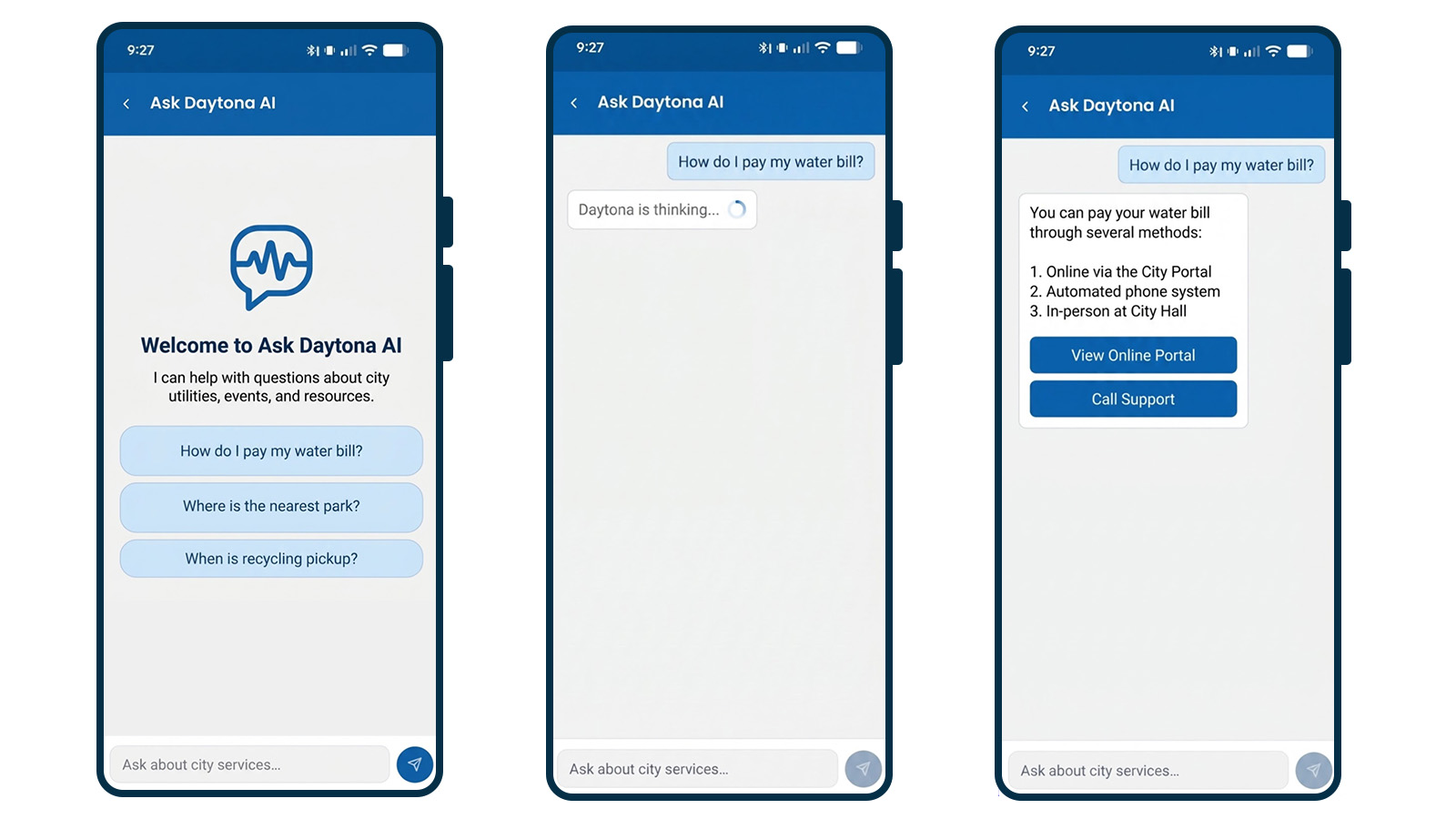
Ask Daytona is an assistant that answers from the City's own published information and nothing else. Three things define it:
It cites its source. Every answer links back to the City page it came from, so a resident can verify it or read further. An answer without a source does not get shown.
It declines rather than guesses. If the answer isn't in the City's information, the assistant says so. It does not answer general-knowledge questions and it does not browse the open web.
It stays current. The assistant's knowledge refreshes from the City's published content on an ongoing schedule, so it reflects what the City says today — not what it said when the app was built. City staff control which content is included.
It is a retrieval-based design rather than a model answering from memory. The practical consequence for a city is that accuracy is a function of the City's own content, which the City controls, rather than of a vendor's model, which it does not.
Designed for the realities of a public agency
Privacy. Conversations are ephemeral. The assistant does not build a history of what an individual resident asked. The City sees aggregate patterns — which topics come up, where answers are thin — not a record of any one person's questions. For a government service, that distinction matters.
Cost control. A city budget is not an AI research budget. The assistant is designed so routine questions are answered as inexpensively as possible and only harder ones draw on more capable models, keeping the cost per answer predictable and modest.
No vendor lock-in. The underlying language model is a configuration choice, not a structural dependency. As the field moves — and it moves every quarter — the City can move with it without a rebuild.
Accessibility. The assistant meets the same WCAG 2.1 AA standard applied across the app, including screen reader support for responses as they arrive.
AI for the people running the city, too
The AI work was not limited to the resident-facing app. The City's content and marketing platform includes AI-assisted authoring that helps staff draft notification copy, event descriptions, and content entries from a short brief — including producing a push notification, a text message that fits its character limit, and an email version of the same announcement.
The practical effect: the person who writes a parks event listing can put it in front of residents across three channels without a communications team in the loop. Access is limited to authorized staff roles.
Security was part of the scope, not an afterthought
An AI feature inside a government application expands the surface that has to be defended, so it went through the same review as everything else. Ahead of release, Sweent commissioned an independent security and authorization assessment of the platform — deliberately testing our own build before it went live — and closed every finding before the work was demonstrated to the City.
That sequencing is, in our view, the part of this project most worth copying. Agencies adopting AI are taking on a category of risk their existing procurement checklists were not written for, and the time to find out is before launch.
What we would tell the next city
Ask Daytona was delivered in July 2026 and demonstrated live to the City, where it was approved along with the rest of the milestone. Four things we would carry into the next municipal AI engagement:
Ground it or don't ship it. Answers tied to official sources, with citations, are the difference between a tool a city can stand behind and a liability.
Refusal is a feature. "I don't have that" preserves trust. A fabricated permit fee destroys it permanently.
Keep the model swappable. Treat the AI provider as a configuration choice and you get to move with the field for free.
Build on what the agency already runs. The fewer net-new systems an IT department has to operate, secure, and budget for, the more likely the capability survives past the launch announcement.
The technology behind it
For those curious about the toolkit: the mobile application is built with React Native and Expo in TypeScript for iOS and Android. The platform behind it runs on Supabase and PostgreSQL, using vector search for retrieval. The assistant is built on retrieval-augmented generation over commercially available large language models, selected per workload. The City's content and marketing platform is a React and TypeScript application. Accessibility is built to WCAG 2.1 AA.
Sweent LLC builds AI-integrated software for government and enterprise clients, with an emphasis on accuracy, privacy, and cost control. SDVOSB · HUBZone · GSA MAS 47QRAA25D0024 · Florida State Term Contract 80101507-23-STC-ITSA. To discuss an AI integration for your agency, contact jtejera@sweent.com.
Frequently Asked Questions
An AI assistant inside the City's mobile app. Residents ask a question in plain language and get an answer drawn from the City's own published information, with a link back to the source.
By grounding it. The assistant answers only from official city information rather than from open-ended general knowledge, it points to the source behind every answer, and it declines rather than guesses when it does not have the information. For a public agency, a confident wrong answer is worse than no answer.
Yes. Conversations are treated as ephemeral and are not kept as a history tied to an individual resident. The City sees aggregate usage patterns that help improve the information available — not a record of what any one person asked.
Yes. Sweent builds AI-integrated software for government and enterprise clients, with an emphasis on accuracy, privacy, and cost control rather than novelty. SDVOSB and HUBZone certified; GSA MAS 47QRAA25D0024 and Florida State Term Contract 80101507-23-STC-ITSA. Contact jtejera@sweent.com.